
VFR Weather Minima Explained: Visibility and Cloud Clearance Made Simple
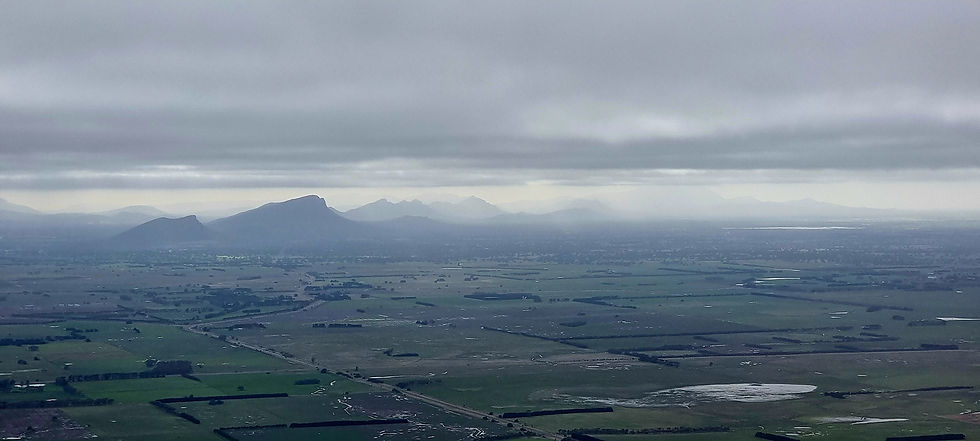
You can see the paddocks, the next ridge and a patch of blue beyond the cloud. Whether you can legally keep flying VFR still depends on where you are and how much room you have around that cloud. A familiar view through the windscreen can sit on either side of the legal limits.
VMC, or visual meteorological conditions, describes the required flight visibility and distance from cloud. For an aeroplane, the normal rules become manageable once you identify your airspace and altitude. The part that catches many students is Class G: its lower-level boundary follows whichever is higher, 3,000 ft above mean sea level or 1,000 ft above the ground.
Start with airspace, then altitude
Find your airspace class on the chart before choosing a set of weather minima. Class C and E use the usual measured cloud distances. Class D has its own distances. Class G has a lower-level provision that allows flight clear of cloud, subject to additional requirements.
AMSL means above mean sea level. AGL means above ground level, so it changes as the terrain beneath you rises or falls. An altimeter set to QNH gives you an altitude referenced to sea level; you must also consider the ground elevation to work out your height AGL.
Flight visibility is what you can see forward from the cockpit. An aerodrome weather report helps you assess conditions, but a reported visibility at the airport cannot establish the visibility along the whole route. Showers or haze may reduce it considerably ahead.
The usual measured distances
Below 10,000 ft AMSL, normal VMC criteria in Class C and E require at least 5,000 m flight visibility, 1,500 m horizontal separation from cloud and 1,000 ft vertical separation. Those cloud distances also apply in Class G above its lower-level boundary.
At or above 10,000 ft AMSL in those classes, flight visibility increases to at least 8,000 m. The cloud distances remain 1,500 m horizontally and 1,000 ft vertically. Exactly 10,000 ft belongs to the higher visibility band.

Picture a cloud with a measured buffer around it. Being comfortably below its base can satisfy the vertical requirement while a cloud bank off your wing still fails the horizontal requirement. Check both dimensions whenever the relevant cloud position makes them applicable. A gap that looks generous through the windscreen can become surprisingly narrow at flying speed.
Class A also appears in the legal VMC table, but VFR flight there requires CASA approval. Normal PPL route planning should respect that separate restriction.
Class G near the surface
At or below the higher of 3,000 ft AMSL or 1,000 ft AGL in Class G, an aeroplane needs at least 5,000 m flight visibility and must remain clear of cloud and in sight of the ground or water. The numerical 1,500 m horizontal and 1,000 ft vertical cloud distances give way to the clear-of-cloud requirement in this band.
This provision also brings radio requirements: the aircraft must have the required radiocommunication equipment, with the applicable listening watch and broadcasts. The ordinary low-level Class G radio-fitment exception does not apply when using these lower-level VMC criteria.
The boundary includes equality. At exactly the applicable limit, the lower-level criteria can apply. Once you climb above it, the measured cloud distances apply, while visibility stays at 5,000 m until you reach 10,000 ft AMSL.

Over low ground
Suppose the terrain is 500 ft AMSL. A point 1,000 ft above it is 1,500 ft AMSL. Compare that with 3,000 ft AMSL: the higher boundary is 3,000 ft AMSL. At 2,800 ft in Class G, the lower-level criteria apply. At 3,200 ft, you need the measured cloud separation.
Over higher terrain
Now put the ground at 3,500 ft AMSL. Adding 1,000 ft gives 4,500 ft AMSL, which becomes the higher boundary. At 4,300 ft you are 800 ft AGL, so the lower-level criteria can apply. At 4,700 ft you are above the boundary and need measured cloud clearance.
Recalculate as the ground changes. At the same 4,300 ft altitude over terrain that falls to 2,000 ft AMSL, the boundary falls to 3,000 ft AMSL and your flight enters the measured-separation band. The altimeter can stay perfectly still while the applicable rule changes beneath you.
Class D has different cloud distances
Normal VMC in Class D requires at least 5,000 m flight visibility and 600 m horizontal separation from cloud. Vertically, remain at least 1,000 ft above cloud or 500 ft below cloud, according to your position. These criteria apply at all heights in Class D.
Read the direction carefully. When you fly underneath a cloud base, the aircraft must be 500 ft below it. When you fly above a cloud top, the aircraft must be 1,000 ft above it. Reversing those figures is an easy exam mistake, particularly when the question gives several heights in quick succession.
A clearance to enter controlled airspace leaves the normal weather requirements in place. If you cannot maintain them, tell ATC promptly and arrange a suitable alternative.
Put the figures into a flight
Try these short scenarios by choosing the rule first and checking the arithmetic afterwards. Assume ordinary aeroplane VFR operations and the stated airspace throughout each example.
A climb in Class G
Over ground at 500 ft AMSL, you climb from 2,800 ft to 3,500 ft. The cloud base is 4,200 ft AMSL and visibility is 6 km. At 2,800 ft, being clear of cloud and in sight of the ground can satisfy the lower-level weather criteria. At 3,500 ft you have only 700 ft below cloud, which falls short of the 1,000 ft measured vertical requirement. Check clearance to any cloud alongside you as well.
A Class E cruise
You are at 6,500 ft in Class E, with a cloud base at 7,500 ft. The vertical separation is exactly 1,000 ft. With 6 km flight visibility, the visibility requirement is also met. You still need the required 1,500 m horizontal separation from relevant cloud. At 10,000 ft in Class E, that same 6 km visibility would fail the 8 km requirement.
A Class D departure
Your planned departure altitude is 1,000 ft AMSL and the cloud base is 1,400 ft AMSL. The 400 ft gap fails the normal 500 ft below-cloud requirement in Class D. A 1,500 ft base would provide exactly 500 ft. The flight must also meet visibility, horizontal separation and the other applicable departure requirements.

If these questions take a few attempts, work through airspace and meteorology together. Our ground school connects the rules with the weather information you use during flight planning, so you can practise identifying the applicable limit before reaching for a number.
Keep special provisions separate
Special VFR is a separate ATC authorisation for qualifying operations in a control zone. For an aeroplane it requires flight by day, clear of cloud, with at least 1,600 m flight visibility. Its limited scope needs careful planning: normal VMC criteria apply once you leave the airspace covered by the authorisation.
The MOS also contains provisions for certain helicopter and night vision imaging system operations. Their reduced visibility or different cloud requirements depend on their own conditions and approvals. Use the normal aeroplane criteria for an ordinary PPL scenario.
Leave yourself room to change the plan
Legal weather minima are only one part of the decision. Low cloud over rising ground may squeeze the available route even when your present position meets VMC. Minimum-height rules, terrain clearance and a usable escape route still need attention. Lowering the nose to stay under every new patch of cloud can quickly spend the space you had reserved for turning away.
Before departure, compare the route's airspace and terrain with the expected weather. In flight, respond while a diversion or return remains straightforward. If the next ridge disappears into cloud or the visibility starts closing in, reassess early and ask for assistance when needed.
The useful habit is to name the airspace, identify the altitude band and then assess the visibility and cloud distances. You can carry that sequence from a practice question straight into the cockpit.
PPL Prep's online ground school brings airspace rules and meteorology together, including the reasoning behind the Class G height boundary and the different Class D cloud distances. The video below introduces the course and shows how it supports preparation for your RPL and PPL theory exams.


Comments