
The Hardest Topics in the CASA PPL Exam (And How to Master Them)
Why these topics often feel hardest
The CASA PPL exam draws together a broad theory syllabus, but three areas often demand the most sustained attention: navigation, meteorology, and performance and flight planning. They are not officially ranked as the hardest subjects. They simply combine more moving parts than a straightforward recall question. You may need to find the right source, interpret a scenario, convert units, complete several steps and then decide whether the result makes sense.
The PPLA exam allows 3.5 hours and requires at least 70 per cent. Questions include multiple-choice items and answers entered as whole numbers. That sounds generous until one navigation or performance problem starts absorbing time. The best defence is a repeatable method that stops small errors from travelling through the whole solution.
The shared challenge: keeping the chain intact
These subjects reward connected thinking. A navigation answer can depend on the correct wind, unit conversion and sign. A meteorology answer can depend on a forecast's validity before the weather itself is considered. A performance answer can depend on using the correct weight, pressure condition and chart sequence. If the first link is wrong, tidy arithmetic can still lead to the wrong option.
A useful study rule is: identify, convert, solve, sense-check, answer. Write the requested quantity and unit before touching the calculator. List the facts supplied in the question. Convert them once, show the working, estimate the likely range and only then choose an answer. This method feels slower at first. With practice, it becomes quicker because you spend less time restarting.
Navigation: make every step visible
Navigation becomes difficult when familiar terms blur together. Track is the path you intend to make over the ground. Heading is where the aircraft is pointed. Bearing describes the direction of one point from another. True and magnetic values are not interchangeable, and a wind correction must be applied in the right direction.

Instead of trying to hold an entire problem in your head, create a small working box. Label the required answer and unit. Record the values given, including whether directions are true or magnetic. Draw a simple wind-and-track sketch. Then work through one operation at a time.
Build one standard navigation workflow
Start by identifying the route and the information source. Confirm the direction convention, then calculate or extract the wind effect, heading and groundspeed. Use groundspeed for time and endurance work, and keep the units beside every figure. If the question moves into revised ETA, track made good or a diversion, start a new line rather than squeezing the correction into the original calculation.
The 1-in-60 rule is a good example. The mathematics is simple, but the setup matters. Separate track error from closing angle, confirm the distance already flown and the distance remaining, and decide which way the correction must go before calculating it. A quick sketch often prevents a sign error that a calculator cannot detect.
Drill the weak link, not the entire subject
When a navigation answer is wrong, classify the reason. Was it the concept, the diagram, a conversion, arithmetic, the direction of correction or the wording? Then practise three more questions that isolate that exact weakness. Repeating whole mock exams without diagnosing the fault can reinforce the same habit.
Mental estimates are valuable even when a calculator is allowed. If a strong headwind produces a shorter flight time, or a small track error creates an extreme correction, stop. The exact answer may still look plausible among the options, so a reasonableness check is part of the calculation, not an optional extra.
Meteorology: turn information into a flight decision
Meteorology can feel like a language course because it contains codes, abbreviations, symbols and timing rules. The exam is testing more than decoding. It expects you to connect the information to cloud, visibility, wind, turbulence, icing, terrain and the proposed flight.
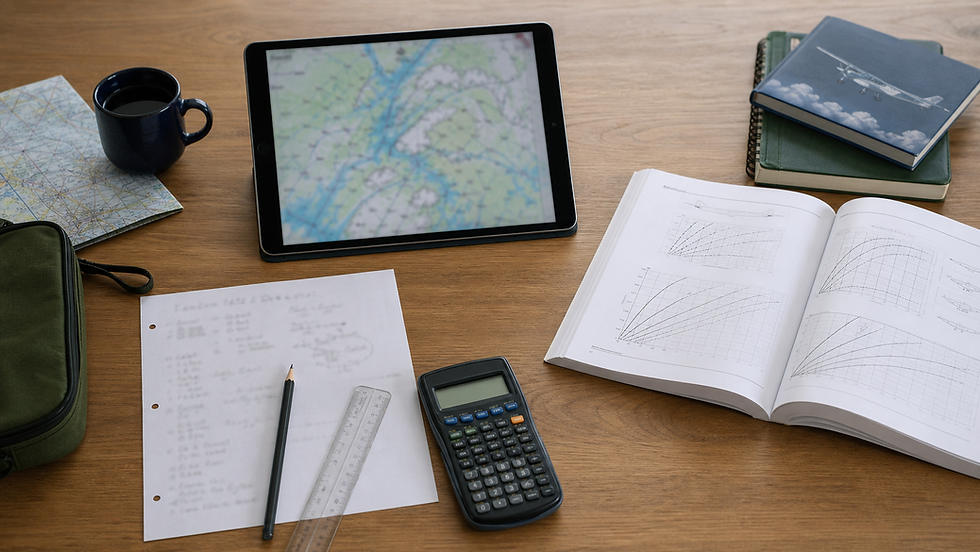
Use a three-stage method: decode, validate, apply. First translate the product into plain English. Next confirm its location, issue time, validity period and any relevant changes. Finally ask what it means for the route, level, departure time and available alternatives. This makes it harder to select an answer that is meteorologically true but irrelevant to the scenario.
Study systems rather than isolated definitions
Pressure, wind, fronts, cloud and visibility belong to the same weather system. Draw the pressure pattern, add the expected wind and then predict the weather before checking the forecast. Compare forecasts with observations so that you learn what is expected and what is happening now.
Work regularly with the current Australian products used in training and pre-flight briefing, including Graphical Area Forecasts, grid point wind and temperature information, TAFs, METARs, SPECIs and applicable warnings. For each product, practise answering four questions: where does it apply, when does it apply, what conditions does it describe and what decision could it change?
Thunderstorms, windshear, mountain waves, turbulence, sea breezes and downdraughts are easier to remember when tied to a cause and an operational consequence. A flashcard can test a definition. A short scenario tests whether you can recognise the hazard in context.
Struggling with Met or Nav? Test your knowledge with our CASA-style practice exams to find your weak spots.
Performance and flight planning: control the sequence
Performance questions are rarely difficult because of one formula. They are difficult because several conditions must be carried into a chart or loading calculation without losing a unit, limit or correction. Flight planning adds route, fuel, holding, alternate, reserve, weight and balance considerations to the same chain.
Begin with an input sheet. Separate aircraft data from environmental data and operational requirements. Record weight, pressure or density condition, temperature, wind, runway information and the performance quantity requested. Do not add a condition that the question has not supplied.
Let the approved data lead the calculation
Practise reading each performance chart in the same order every time. Identify the correct chart and entry condition, follow the printed sequence carefully, apply only the stated corrections and write down the intermediate result. If the answer requires take-off or landing distance, confirm exactly which distance the question requests before selecting an option.
For loading questions, keep weight, arm and moment in separate columns in your working. Recalculate after any passenger, baggage, fuel or ballast change. A result within maximum weight is not automatically acceptable if the centre of gravity falls outside its permitted range.
For fuel planning, create a clear sequence from start, taxi and trip fuel through holding, alternate and reserve requirements. Keep usable fuel, endurance and weight concepts separate. Then cross-check the result against the rest of the plan. An answer that meets one line of the calculation but conflicts with the aircraft's limits needs another look.
Create a performance sense-check library
Build a short list of directional effects you can predict before using a chart. Higher temperature and elevation generally reduce take-off and climb performance. A tailwind increases the ground distance needed. Extra weight normally works against performance. These are not substitutes for the approved data. They help you spot when a chart has been entered from the wrong side or a correction has been applied backwards.
How to handle CASA-style wording
A question can feel tricky when several answers look close. Often the deciding detail is a qualifier, the unit requested or the exact stage of flight. Slow down for words such as “not”, “except”, “first”, “least”, “most appropriate” and “approximately”. Mark them before reading the options.
Read the stem before the answers
State the task in your own words: “I need magnetic heading”, “I need fuel remaining” or “I need the valid forecast for this time”. This gives you a target before the distractors appear. If the options contain different units, convert the question into the requested unit before comparing them.
For a calculation, estimate the order of magnitude first. For a judgement question, identify the governing principle and apply it to the facts given. Do not import an assumption from a similar practice problem. If two options seem possible, return to the exact wording and ask which one answers the stated question most completely.
A study loop that builds exam reliability
Use the same four-stage loop each time you revise. It keeps practice focused on the cause of an error and then tests whether the repaired skill survives under exam conditions.
Diagnose
Begin with a timed mixed set to locate your weak areas. Record more than the score. Tag each error as knowledge, setup, chart use, units, arithmetic, wording or time pressure. A pattern of unit errors needs a different response from a gap in meteorology.
Rebuild
Work the weak skill untimed and show every step. Explain the solution aloud as if teaching another student. If you cannot explain why a correction is applied or why a weather product is valid, return to the underlying lesson before doing more questions.
Repeat
Complete several variations of the same problem until the workflow is stable. Change the wind, time, weight or forecast validity so you cannot rely on memorising the answer. Keep your error log beside you and note whether the original mistake reappears.
Integrate
Return to mixed, timed practice. Navigation, weather and performance are connected in real flight planning, so the final stage should require you to switch between subjects without losing your method. Review every guess, including the guesses that happened to be correct.
Prepare your exam materials as carefully as your knowledge
Practise with the current documents and equipment you plan to use. CASA's permitted-material rules specify which document sets and tools are allowed, and electronic devices are not a replacement for the permitted exam equipment. Check the current CASA page before your sitting because operational details can change.
Know where to find information without filling your documents with prohibited notes or tags. In the final week, use your reference material as part of timed practice. The aim is to retrieve the right information calmly, not to search from the first page whenever a question mentions airspace, weather or planning data.
During the exam, protect your time. Answer straightforward questions cleanly, mark demanding calculations for review and leave enough time to check units, direction, signs and reasonableness. Treat 70 per cent as the pass mark, not the target for your preparation.
Master the method, then trust it
Navigation, meteorology and performance planning become manageable when every problem has a known starting point and a consistent sequence. Build the concept, show the working, check the result and learn from the exact reason an answer went wrong. That is how difficult topics turn into dependable marks.


Comments