
How to Get a PPL in Australia: CASA Requirements, Hours and Exams Explained
Your first flying lesson can involve taking the controls within minutes of leaving the ground. Getting a Private Pilot Licence takes longer, partly because you are learning to make the decisions that let you leave the instructor behind. Choosing a suitable day for a flight becomes as much a part of the job as landing the aeroplane.
To get an aeroplane PPL, you must be at least 17, meet the English and medical requirements, complete approved flight training and pass the PPLA theory exam and practical flight test. You also need the required aeronautical experience and an aviation security status check before completing the licence application.
The headline minimum is 35 hours on an integrated course or 40 hours on a non-integrated course. Allow room beyond those figures: an average student reaches PPL standard after around 55 to 60 flying hours. Here is how the whole process fits together, from choosing a school to applying for your licence.
Contents
Start with the licence you want
A PPL allows you to act as pilot in command in private operations, subject to your aircraft qualifications and the conditions of the flight. For most new aeroplane pilots, the initial aim is daytime flying under visual flight rules in a single-engine aeroplane. Night flying and instrument flying involve additional qualifications.
You can work towards a PPL from the beginning. Holding a Recreational Pilot Licence first is optional, although many schools use the RPL as a useful stage along the way. If you already hold an RPL, your school assesses the training and experience you can credit towards the PPL.
The choice depends partly on the flying you want to do. A local recreational goal and a plan to travel cross-country with friends can lead to different initial training decisions. Our RPL versus PPL comparison explains the differences before you commit to a course.
Age, English and your CASA number
You can begin lessons before reaching the age for a licence. The minimum age for student solo flying is 15, while the minimum age for a PPL is 17. Your instructor decides when your flying is ready for solo within the applicable requirements; a birthday alone never establishes readiness.
Apply for an Aviation Reference Number, usually called an ARN, through myCASA early in training. It identifies you in CASA's systems and is required before your first solo. Have your identity documents ready and keep your personal details consistent across applications and exam bookings.
English requirements also have stages. Your school checks the English proficiency needed for student flying. For a PPL, you need an Aviation English Language Proficiency assessment at ICAO Level 4, 5 or 6. Level 4 remains current for three years, Level 5 for six years and Level 6 indefinitely.
Even if you speak English every day, arrange the assessment with your school. Understanding a changed clearance while managing an aeroplane is a specific communication task, and the required assessment needs to be recorded properly.
Choose a school and understand the course
PPL training takes place with an authorised Part 141 or Part 142 flight training operator. Ask which course you would actually join, which aircraft you would fly and how often you can book them. A school that offers several programmes should be able to explain the one covered by your quotation.
An integrated PPL course combines theory and practical flying in a structured programme through a Part 142 operator. Its minimum aeronautical experience is 35 hours. Non-integrated training is provided through a Part 141 operator and has a 40-hour minimum. It commonly suits students fitting lessons around work or other commitments.
The five-hour difference deserves its proper place in the decision. Lesson continuity, instructor availability and the cost of reaching test standard can have a much larger effect on your experience. Ask what recent students with a schedule like yours have needed, and whether the quotation includes briefings, landing fees and the flight test.
An inexpensive hourly rate can look less attractive once you discover what sits outside it. Use our guide to the cost of a PPL to build a budget that includes the whole course and some flexibility for extra training.
Arrange the right medical early
A Class 2 medical is the usual starting point for private pilots. It involves assessment through a Designated Aviation Medical Examiner, or DAME. A current Class 1 medical also supports the PPL route, which may be relevant if professional flying is your longer-term aim.
Eligible applicants can also take a PPL flight test with a current Basic Class 2 medical under the applicable exemption. Basic Class 2 has eligibility criteria and operating conditions, including restrictions on the flying you can do after qualification. Discuss the intended aircraft and training with your school before choosing that route.
A Class 5 medical self-declaration does not qualify you to take the PPL flight test. Some flying may be possible under that scheme, but you need a medical route accepted for the test when you reach that stage.
Sort this out before spending heavily on training. If additional reports are needed, organising them while you begin theory is easier than discovering the delay when your instructor is ready to send you solo. Our CASA medicals guide explains the main options and how the assessment works.
Learn to fly, then progress to solo
Early lessons establish control of the aeroplane and a dependable lookout. You gradually add take-offs and landings, with emergency procedures woven into the training. Circuit practice makes the workload particularly obvious: the runway comes round again surprisingly quickly when you are learning the radio calls as well as the approach.
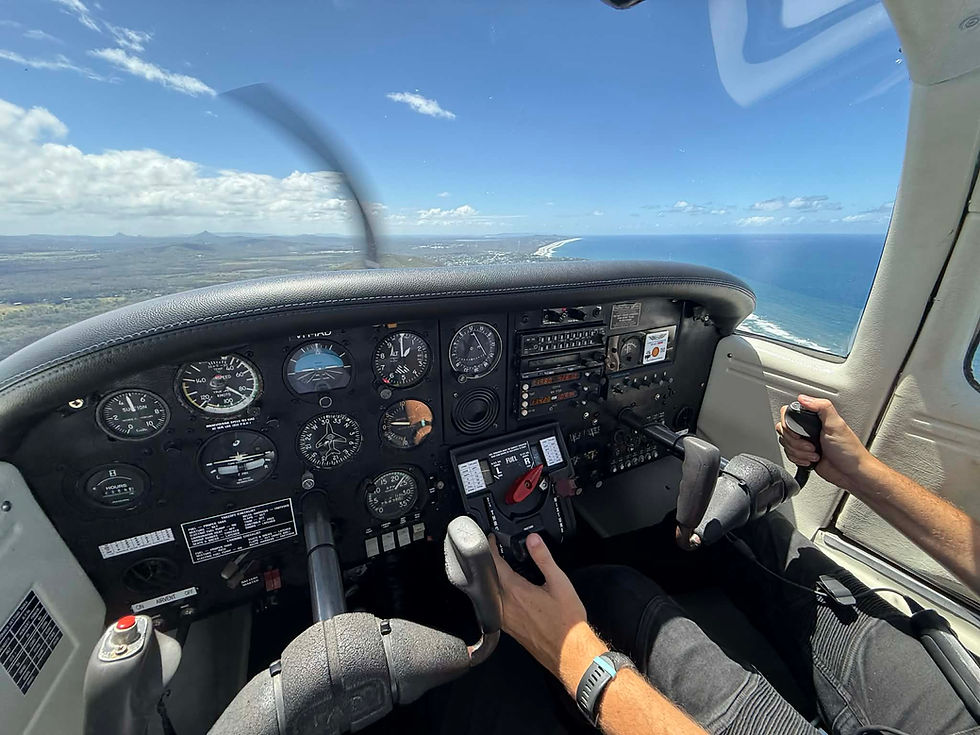
Your first solo follows demonstrated competence and your instructor's approval. You need the appropriate medical arrangements and an ARN, as well as meeting the age and other student-pilot requirements. Solo flying remains supervised and authorised by the training organisation, with the instructor setting the limits for the flight.
Student solo flights carry no passengers. The empty instructor's seat is an exciting milestone, and it also leaves you responsible for recognising when a circuit or approach needs to be discontinued. Your training prepares you to make that decision without waiting for a prompt.
As the course develops, you move beyond the familiar local area into navigation training. Dual lessons introduce route planning and diversions before you undertake authorised solo cross-country flights. Keep your logbook accurate throughout; the entries eventually demonstrate that each experience requirement has been met.
Understand the 35-hour and 40-hour minimums
The total requirement is called aeronautical experience because approved simulator time can form part of it. On an integrated course, the 35-hour total includes at least 30 hours of flight time as a pilot. On a non-integrated course, the 40-hour total includes at least 35 hours of flight time as a pilot. Both require at least 20 hours as pilot of an aeroplane.
Up to five hours of the overall minimum can therefore be completed as simulated flight time in an approved flight simulation training device, subject to the course and the specific experience requirements. Time spent using a home flight simulator cannot simply be entered towards the licence minimum.
Both routes also require:
At least 10 hours of solo flight time in an aeroplane.
At least 5 hours of solo cross-country flight time in an aeroplane.
At least 2 hours of dual instrument time, including at least 1 hour of dual instrument flight time in an aeroplane.
These categories overlap. The solo cross-country hours contribute to the solo total, so five hours of solo navigation does not sit on top of ten separate hours of local solo flying. Similarly, the airborne instrument hour contributes to the two-hour instrument requirement.
The basic instrument training teaches you to control the aeroplane using its instruments when outside visual references are unavailable. It forms part of the PPL course; permission to plan flights under instrument flight rules requires further qualification.
Reaching the minimum experience only completes one part of the requirement. You must also demonstrate the required competence. The average of around 55 to 60 flying hours is a more realistic starting point for discussing the likely course budget, with your own progress determining when you are ready.
Study for the PPLA theory exam
Start theory alongside flying. Aerodynamics becomes easier to remember when you can connect it to a control movement you have just made, while weather study starts earning its keep when you are deciding whether the next lesson can go ahead.
The PPLA exam brings the aeroplane PPL subjects together in one examination. You have three and a half hours and need at least 70% to pass. Questions include multiple-choice answers and entries where you type a whole number into a box.
Your preparation covers air law and flight rules, aircraft knowledge, human factors, meteorology, navigation, and performance and flight planning. Calculation practice needs to include choosing the right information as well as getting the arithmetic right. A neatly calculated answer using the wrong aircraft weight still gives the wrong result.
For the booking process and exam preparation, see our complete guide to the CASA PPL exam. Check the current permitted-materials rules before your sitting and practise with the equipment you will use.
PPL Prep's online ground school helps you build those subjects alongside your lessons. Working through the theory before the relevant flight gives you a better chance of understanding the briefing and using the airborne time well.

Keep your result advice and any Knowledge Deficiency Report after the exam. A KDR identifies topics that need further work. Your training provider or examiner reassesses that knowledge before the relevant flight-test requirements are completed. A pass mark is a useful milestone, and the remaining gaps still deserve attention.
Complete the 150 NM solo cross-country flight
Your five hours of solo cross-country experience must include a flight of at least 150 nautical miles, with a full-stop landing at each of two aerodromes outside the flight training area of the aerodrome where the flight began. This applies to both integrated and non-integrated aeroplane PPL training.
The 150 NM refers to the qualifying flight's distance. Each leg does not need to be 150 NM. The two required landings must be full stops, so a touch-and-go at each destination would fail to meet that part of the requirement.
Your instructor helps establish an appropriate route and authorises the flight when you are ready. By then you will have practised the planning and navigation skills needed to manage it, including what to do when conditions require a change of plan.

This is where the purpose of the earlier lessons becomes particularly clear. A departure time affects the weather you expect along the route; a stronger headwind changes the fuel picture. You learn to keep checking the plan against the flight you are actually experiencing.
Allow weather flexibility when scheduling the qualifying trip. A postponement can be the sound result of your planning. The distance requirement gives the flight a training purpose, while the decision to depart still depends on suitable conditions.
Pass the flight test and complete the paperwork
Your school prepares you for a flight test with an authorised examiner once the training and experience requirements are met. The test includes a ground component and practical flying. Expect to explain your planning decisions and demonstrate safe operation across navigation and aircraft-handling tasks, including simulated emergencies.
The examiner needs to see that you can manage the flight as pilot in command. A smooth landing helps, but the assessment also includes decisions made before the engine starts and your response when circumstances change. Our PPL flight-test guide explains how to prepare for that broader assessment.
Arrange your aviation security status check well before this point. An ASIC is needed for operations at security-controlled airports and for applicants under 18 under the current security guidance. For eligible applicants aged 18 or over whose flying does not require an ASIC, an AVID can meet the security-status requirement. An AVID does not grant unescorted access to secure airport areas.
Ask your school which option fits its airport and your intended flying. Allow four to six weeks for processing, with room for delays if further information is requested. Our ASIC application guide helps you organise that part of the process.
Apply to CASA for your licence through myCASA, coordinating the supporting records with your school and examiner. Check the application details against your ARN record and confirm that the flight-test outcome and required evidence have been submitted. Completing the test and completing the licence application are separate steps.
Turn the requirements into a workable plan
Your next step can be a trial instructional flight followed by a proper discussion with the school about availability and costs. Bring your intended flying goal to that conversation, and ask how the training will fit the time you can reliably give it.
For someone training full-time, the PPL may take around two months; at roughly one flying hour a week, allow just over a year. Weather, aircraft availability and your progress can extend either estimate. Regular lessons and preparation between them help you spend less of each flight rediscovering what felt familiar last time.
Getting your medical underway and beginning theory early lets useful work continue between flying days. From your first circuit to the 150 NM navigation flight, PPL Prep's ground school explains the theory behind the decisions you will practise with your instructor.


Comments